
Phil Stitelmann is a cyberpunk author, with two novellas in his cyberpunk universe, Digital Gods and Fallen Angels, currently available, and several more projects in development. Today, we take a look at Phil’s cyberpunk universe, and talk to him about his writing, and his cyberpunk influences.
How did you get into writing?
Through my English studies, mostly. But it is reading the Lord of the Rings that triggered the real need to write!
What particularly struck me was Tolkien’s worldbuilding, sense of epic and, most all, mythologie. These concepts never really left me. Writing remained alongside my professional career for years until Digital Gods and Fallen Angels grew into something I could no longer treat as a side project. Today, with the concept of the digital gods, I have a mythologie of my own, set in a cyberpunk environment!
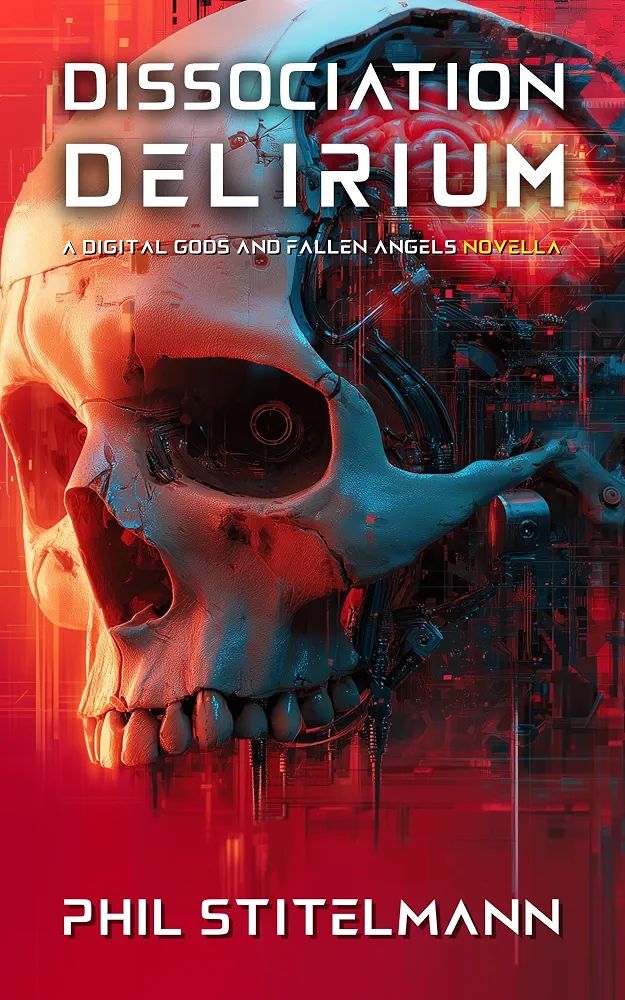
Phil’s first novella in his cyberpunk world was Dissociation Delirium.
A Cyberpunk Story of a Corporate Burnout With a Bodycount
Bob Mitchells works for EuroCore. Top-tier megacorp. Cutting-edge cybernetics. A chance for him to rise. All it takes is absolute commitment. Long hours blur into endless days. Sleep becomes optional. Corners are cut.
Then something shifts in the tech within him. Subtle at first. Then much, much worse.
As his reality fractures, Bob uncovers the true, horrific cost of corporate ambition: where madness comes with a bodycount.
A brutal descent into cybernetic psychosis, Dissociation Delirium blends hard science fiction with psychological and body horror, exposing the cost of human augmentation in a world where profit overrides sanity… and where even your mind no longer belongs to you.
Dissociation Delirium begins as almost a humorous satire on the corporate culture within the Digital Gods and Fallen Angels setting of Neo los Angeles, telling the story of a corporate drone doing whatever is asked of him in hopes of climbing the corporate ladder, including using an experimental tech implant. The story quickly, however, descends into a very dark place, with a suitably brutal ending. In our everyday world, there are plenty of immoral corporations taking advantage of their employees, but Dissociation Delirium takes that concept to the extreme, and gives you a very good feel for the contempt with which the power brokers of the world treat the people below them. It’s a brutal and bloody read.

What inspired the cyberpunk universe you’ve created, and your existing cyberpunk novellas?
Digital Gods and Fallen Angels is a love story to pop culture, scifi, and everything that shaped who I am now. In the books, you will find hidden references to almost every 90s movie imaginable. But most of all, it was Cyberpunk 2077 and its incredible writing that shaped my own work. Now, DGFA is NOT fan fiction in any capacity. The one thing I kept was the deep, tragic personal story and the devastating emotional scale.
With Digital Gods and Fallen Angels I wanted to combine street-level cyberpunk with genuine epic scope. The story begins with talented-yet-damaged people surviving in the neglected parts of Neo Los Angeles then gradually expands towards artificial consciousness, digital gods and planetary consequences.
It is mostly the scale that sets DGFA apart from current cyberpunk fiction. You will feel in a roleplaying game, where the players organize as a group to fight odds that become so much larger than themselves.
Yet love, grief, identity and found family remain at its core.
The novellas let me explore individual parts of that society on a much more intimate scale, all the while adding specific parts of my worldbuilding in each of them.
Dissociation Delirium deals with corporate burnout, psychological fragmentation and the commodification of the augmented body. No Future Tonight focuses on poverty, first love, cybernetic illness and young people trapped inside a system designed to keep them at the bottom. Kaia and Jax are not chosen ones. They are two street kids trying to survive a single night in a city that takes everything from them. That perspective captures the punk heart of the genre for me.
The next novella, Worst Case Scenario, centers around a team of veteran mercenaries facing a nasty case of Murphy’s Law during a corporate asset “transfer” mission that goes wrong in every aspect possible.
Phil’s second novella was No Future Tonight: A Cyberpunk Story of Rage Against the System, which veers away from the corporate focus of Dissociation Delirium, instead taking a look at the situation in the slums and backstreets.
Neo Los Angeles: the city that takes everything and gives nothing back .
When cybernetic illness, gang violence and betrayal shatter their fragile lives, two young street lovers must fight through one brutal night to survive in a city that devours the weak.
A standalone cyberpunk novella set in the world of Digital Gods and Fallen Angels, No Future Tonight asks a simple question: what happens when people born without power try to escape a system designed to crush them?
Stitelmann wastes no time in introducing the reader into the seedier parts of his universe. Neo Los Angeles is, on the face of it, a technologically advanced, growing city. Our protagonists, however, live life well on the fringes of that. Life in the shadier parts of the city is a lot harder, and with his description and narration, the author makes this very clear. As Kaia and Jaxn’s night takes a turn for the worse during an encounter with some of the worst of the worst, Stitelmann lays out exactly what the heroes have to be afraid of, pulling no punches in the process.
He isn’t afraid to paint with a dark brush, giving the terrifying reality of the characters’ situation an authentic, visceral feel. The world and characters feel real, because it isn’t just about heroic characters against black and white villains. The police are uncompromising in their treatment of the street kids, but are also pragmatic in their approach. Where they could sit back on their laurels, and book the two youths on a string of offences, they do accept the offer of a bigger fish.
No Future Tonight is a mantra throughout the book, a shorthand for the hopeless situation the protagonists find themselves in, and apt description for the dangerous underworld at large. As an introduction into the world and setting, No Future Tonight is more than successful, both brutal and thrilling, long enough to tell a full story, but with enough left on the table to leave you wanting more.

What does the title No Future Tonight mean?
You can connect the punk slogan from the Sex Pistols’ song God Save the Queen “No Future” with Kaia and Jax’s generation: young people denied healthcare, security and any meaningful path forward and upward. In a world hellbent on crushing you, can you really escape your social condition?
“Tonight” then gives that social condition brutal immediacy. They may not survive long enough to worry about tomorrow.
Your stories can get extremely dark. Do you consider your work nihilistic?
No. My stories can feel brutal and sometimes devastating but darkness and nihilism do not mean the same thing.
Nihilism says that nothing matters. My characters suffer precisely because things matter to them so desperately: love, dignity, loyalty, memory and the right to choose what happens to their own bodies and lives. The systems surrounding them try to strip those things away. Their struggle to preserve them gives the stories their meaning.
No Future Tonight captures that idea in its harshest form. Kaia and Jax live in a society that offers them no credible future. Yet their love still matters. Their choices still matter. The fact that the world may punish them for those choices does not make them meaningless.
I write tragedy, not nihilism. The darkness measures the cost of remaining human inside a system designed to make humanity unaffordable.
But, at the end of the day, it is hope, rebellion and sacrifice that shine the tiniest spark of hope in the darkness.
Dissociation Delirium and No Future Tonight are just a small part of Phil’s cyberpunk universe, Digital Gods and Fallen Angels. He plans to release several more stories set in this same cyberpunk world.
What are you currently working on?
Right now, the extensive revision of Book 1 in the four-volume Digital Gods and Fallen Angels saga. The complete story already exists in draft form and runs to more than one million words. I am now tightening the prose, pacing, structure and technical detail to bring the opening volume to its final form.
Important message here: if you start DGFA, you will get to the end, for it is written! I will not put a GRR Martin on my readers.
At the same time I am preparing further standalone novellas set in Neo Los Angeles. Worst Case Scenario follows a veteran mercenary team whose supposedly routine corporate extraction descends into absolute disaster. Game Over explores hacking, corporate cybersecurity and the consequences of believing you are smarter than the system hunting you.
Wrong Victim will follow a dark and twisted protagonist. The twist should leave the readers panting.
I am also developing Dream of Mars, a much darker neo-noir investigation centred on Joe Valentine, one of the novels’ main characters. This one will be the real entry point into the main saga.
Eventually these stories will form a collection before the main saga begins publication.
How has your experience working in the computer industry informed your writing in the cyberpunk genre?
Working in software development, AI, cybersecurity and regulated technology gave me a practical understanding of how complex systems actually function. And how they fail.
Technology rarely collapses because of one dramatic mistake. Failures emerge through bad incentives, weak governance, exhausted people, incompatible systems, ageing infrastructure, budget constraints and countless minor compromises accumulating over time: the technical debt.
Cybersecurity works the same way. Behind every spectacular breach lies an attack surface built from technical vulnerabilities, human behavior and organizational decisions. Most of the time, the problem lies between the chair and the keyboard…
That experience helps me ground the technology in something credible, almost hard science. When I write about neural interfaces, artificial intelligence, cybernetic implants or corporate networks I consider infrastructure, security, maintenance and unintended consequences.
Phil has a keen interest in the wider genre of cyberpunk, and has even been a guest on the Hosts in the Shell podcast with hosts Jon Richter and Matt Adcock, talking about Neill Blomkamp’s 2013 dystopian action film Elysium.
Do you remember how you were first exposed to cyberpunk?
I must have been around ten when I first watched Blade Runner, back in 1989. This movie changed everything. I fell in love with the aesthetic and music. Some themes did not register straight away, but later after many rewatches.
Cyberpunk is many different things to many different people, what is it to you?I see the genre as a complex socio-cultural lens and almost a form of speculative anthropology. It examines what happens when technological power develops faster than our willingness or ability to distribute it fairly. Think Mike Pondsmith’s concept of techno shock, for example.
The genre involves far more than just neon lights, hackers and cybernetic implants. It sits at the collision point between technology, ultra-capitalism, social inequality, identity, bodily autonomy and institutional control. The “punk” matters as much as the “cyber.” Cyberpunk looks at the future from the street rather than from a corporate boardroom or the bridge of a utopian starship.
Technology itself rarely plays the villain. The real questions concern ownership, access and coercion. Who controls the technology? Who profits from it? Who gets improved by it and who gets consumed?
At its best cyberpunk takes today’s societal issues and intensifies them into something that could be seen as parodic right now, but could very well become a new kind of normal tomorrow.
What are your favourite pieces of cyberpunk media?
Cyberpunk 2077 occupies the top position. I consider it an extraordinary achievement in world-building, environmental storytelling and character development. Beneath the violence and spectacle lies a deeply emotional story about mortality, identity and the need to leave something behind.
Then comes The Matrix. I wrote an academic paper about it through the lens of Lacan’s concept of the Real and the veil separating us from it. Its combination of philosophy, action, simulated reality and systemic control still fascinates me.
Finally I would place Blade Runner and Blade Runner 2049 together. The original introduced me to cyberpunk while 2049 expanded its questions about consciousness, memory and loneliness without losing the atmosphere that made the first film so powerful.
Finally, of course, Ghost in the Shell – the Oshii 1995 adaptation – left its mark on me.
Together they form one of the most profound explorations of artificial humanity, consciousness and identity ever put on screen.
What are your interests outside of writing cyberpunk?
Music probably takes up the largest part of my creative life outside fiction. I play the piano, electric guitar and drums and I also compose. Music became part of the Digital Gods and Fallen Angels project itself: I wrote an entire album for Angie NightFire, the rockstar at the center of the saga.
I also enjoy video games, tabletop role-playing games and cinema. Games such as Cyberpunk RED, Call of Cthulhu and The Witcher have been scratching that same world-building and storytelling itch for the last thirty years.
Beyond that I play chess, follow developments in AI and cybersecurity and enjoy hiking and paragliding whenever I need to get away from screens and fictional dystopias for a while.
You can find out more about Phil Stitelmann’s Digital Gods and Fallen Angels universe, and where to buy his books, at www.digital-gods-and-fallen-angels.com/

Leave a Reply