
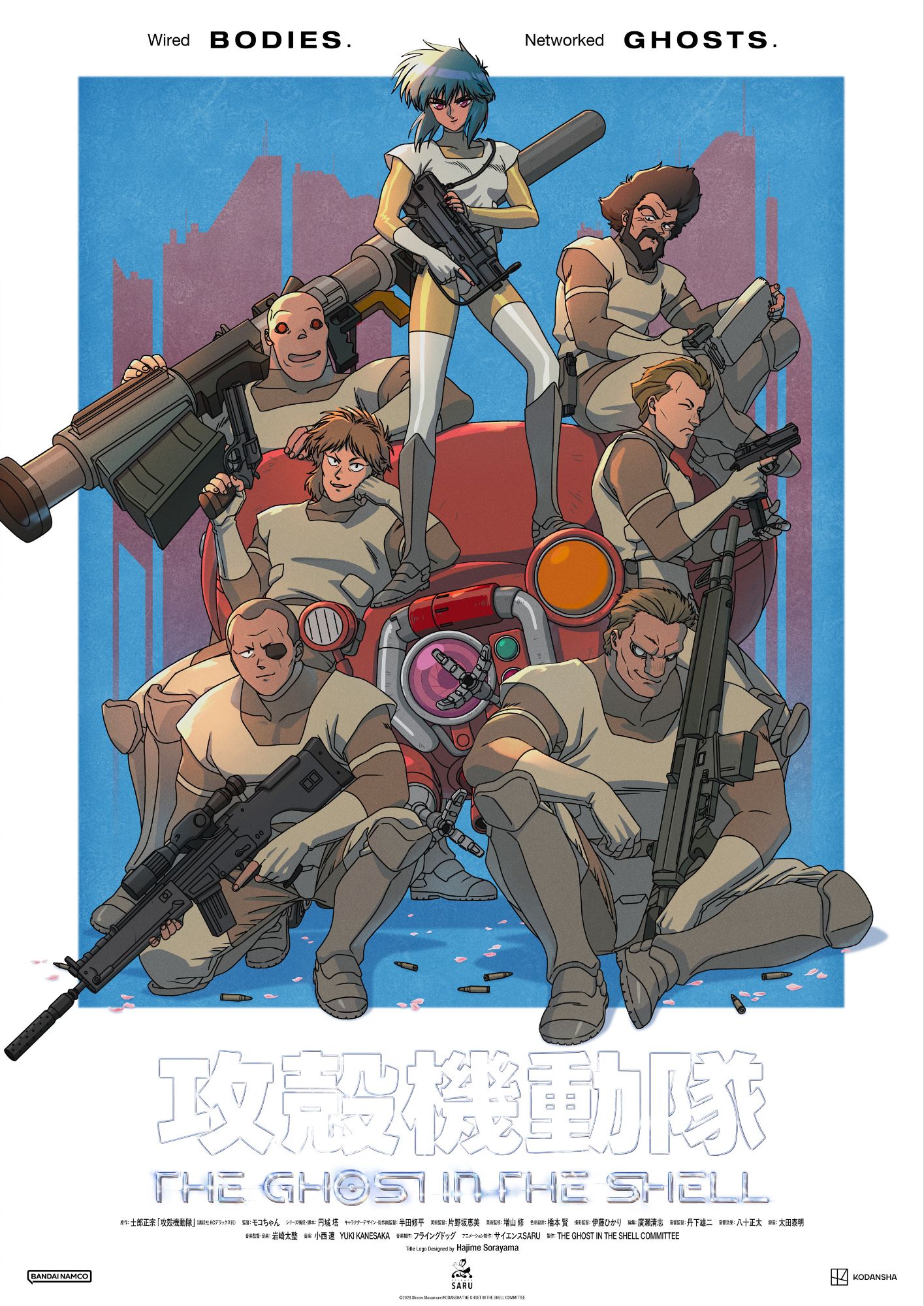
Last week, the 10th and final episode of the new animated Ghost in the Shell series released on Prime Video, concluding the season, and maybe the series. The new animated series was produced by Science SARU, based on Masamune Shirow’s 1989 manga series. The series began airing on 7th July on a simultaneous global release schedule, with weekly episode drops, giving the worldwide community the chance to discuss the series episode by episode.

In the first few episodes, we had the inception of Section 9, after a bit of a false start, then a couple of cases of mistaken identity with regards to The Puppet Master. In the mid-season episodes, the series had moved away from the Puppet Master arc introduced early on, and we got a string of self-contained episodes, featuring rampant cyborgs, corrupt government officials, and international terrorists. Episode 7 brought us back to the Puppet Master story arc, and episode 8 dealt with some of the fallout. At the end of episode 8, we discovered The Major had been caught on film executing a youth as part of an operation, and episode 9 saw her going under trial, but ultimately running away. Then episode 10 concluded the story, with The Puppet Master looking for help to preserve their existence, and further ‘evolve’, suggesting merging with The Major’s consciousness, who agreed to the proposal. Once back in a physical body, The Major left Batou and Section 9 behind, to explore a whole new world.
From the very first episode, reactions to the new series were mixed. Fans of the original Manga were delighted with the similarities in style and tone to the source material. The new series was hand drawn, the characters looked exactly as they were originally drawn, and the tone was a lot more comedic, as writer and illustrator Masamune Shirow had intended. Many fans of the 1995 movie, however, were not as impressed. That 90’s movie is a lot more serious in tone, and does not have the wackiness of the Manga, or the new series. This was, for many, quite a jarring difference, and some immediately turned off.
The first couple of episodes, where the series was finding its feet, and setting up its premise, were a little structurally disjointed. Bouncing around between locations, characters, and story elements, it was a little disorienting, and so many new characters, names, and information made them tricky to follow. Again, this first impression would have lost the show a decent number of viewers.

At this point, online discourse revolved around the differences between this adaptation and the 90s movie, and how some of the plot elements were hard to follow. Once the show hit its stride, though, some of these problems were resolved. There were a number of standalone story episodes around the middle of the run, and these were arguably the best of the episodes. They followed a linear progression, with a set-up at the beginning of the episode, some investigation and conflict, and then a resolution at the finale. Discussion about the series was at this point a lot more positive, with many of those not enamoured by the tone checked out anyway, and others getting used to the tonal shift, and enjoying the episodes.
A throughline of the series, though, is a difficulty following exactly what was going on. There are a lot of names, characters, organisations, fictional countries, and criminal groups mentioned over the course of the series, some which recur, and some that are never heard about again. This can make it tricky to follow, and as a viewer you can remain off-balance trying to keep up with the political machinations, and the ramifications of the events that are happening.

This is where the real dichotomy of the series lies. It is, in terms of animation, tone, and wacky humour, very much in keeping with other anime series. This means that, in theory, it appeals more to general anime fans. Viewers who were more into the serious tone of the 1995 movie, and harder edge, serious cyberpunk in general are not accustomed to the general tone of anime. This series combines action with wacky humour, flights of whimsy, and some downright silliness with some of the hi-jinks of the Fuchikomas.
However, this Ghost in the shell series covers a lot of serious ground. The violence is brutal, and the protagonists are not necessarily heroic in the traditional sense. Suspects are gunned down rather than caught, captured, and brought to justice. There is a heavily political bent to proceedings, as well as a lot of existentialist exploration about human identity, consciousness, and where the line sits between the physical, the digital, and the spiritual. These are heady topics not necessarily explored as much in mainstream anime, leaving a decent percentage of the general audience scratching their heads.

Can a series straddle that line and appeal to both sides? The jury is out on that. There has been plenty of conversation about the show in various forums, Reddit, and social media. The most enthusiastic discourse I have seen, however, has been about shots of Motoko Kusanagi’s butt from the series. It is not a good sign when the largest area of common ground between mainstream anime fans and hardcore cyberpunk fans around the series is how hot the animated protagonist is. That’s not to judge people’s interests, but it’s not really the crux of the series, or what the producers would have hoped people would focus on.

It is difficult to judge the success of the series. Prime Video do not really release ratings, and as a global property, it would be difficult to know what would be considered a success and what wouldn’t with regards to viewing figures. A sure mark of the effectiveness of the show would be if a second season is announced, but actually I have no idea if this was ever a consideration. The series wrapped up the Puppet Master arc, The Major left section 9 behind to explore the world, and discover her new self, so it was left at a natural stopping point. There are definitely more stories that can be told, but only time will tell whether they will be or not. Until and/or unless that happens, this Ghost in the Shell series sits as an interesting experiment, as entertaining to some as it was frustrating to others.
What were your ultimate thoughts on the series? Please let us know in the comments.
Cyberstopia now has a Discord server! Please join us and build a community for cyberpunk and dystopia discussion. We have sections for all the latest news, channels for discussion of The Ghost in the Shell series, as well as upcoming shows like Edgrerunners 2, Blade Runner 2099, and Neuromancer, as well as an author section with a number of cyberpunk authors talking about their work, giving updates on your current projects, etc… It’s a great place to hang out. https://discord.gg/qgMBwC5X8



Leave a Reply